


Your three-year-old hands you the iPad. Again. It’s 4:47 PM and dinner hasn’t started and you have one work email left and the screen is right there and you know what happens next. You hand it over.
That moment is the whole conversation. Not the number of hours. Not the apps. The moment you hand it over and feel just a little worse than you did five minutes earlier. If that feeling is happening more often than it used to, your kid’s screen time is probably too much. Not because of a rule. Because of what your gut is telling you.
Thus, this guide offers practical parenting tips on screen time, written by a conscious parenting coach where patterns, approach & solutions will give you the way to deal with your kid.
What “Too Much” Actually Looks Like
Forget the hour count for a second. The real signal is behavior. If your kid melts down when the screen turns off, that is too much. If your kid stops playing pretend and only wants screens, that is too much. If your child’s vocabulary, sleep, or ability to focus has noticeably changed over the last six months, that is too much.
The clinical guidance does exist. The American Academy of Pediatrics broadly suggests:
- No screens under 18 months, except video chat with family
- 18 to 24 months: limited high-quality content, co-viewed with a parent
- 2 to 5 years: up to one hour per day of high-quality programming for children aged 2–5 years.
- 6+ years: consistent limits, prioritising sleep, school, physical activity, family time
The guidelines provide a helpful starting point, but your child’s behaviour is the clearest indicator of whether screen time is working for your family. Both deserve attention.
Why Screen Time Hits Differently for Different Kids
Not every kid responds to screens the same way. Two children, same household, same hours, and one is fine and one is dysregulated for three hours after. The difference is temperament, plus how the screen is being used.
1. Sensory sensitivity. Kids with greater sensory sensitivity often crash hard after fast-paced shows or bright animation
2. Content type. Algorithm-driven short-form (TikTok-style, autoplay YouTube) tends to be more stimulating and may encourage repeated viewing through rapid rewards and autoplay.
3. Co-viewing vs solo. A parent watching alongside changes the experience completely. Solo, headphones-on screen time can become deeply absorbing, making transitions more difficult.
So the same hour can be wildly different. A parent and a kid watching Bluey together and laughing at the same bits, that is a connected hour. A kid alone on autoplay YouTube Shorts for the same hour, that is something else.
The Conscious Parenting Frame on Screens
Conscious parenting is not anti-screen. It is an anti-reaction. You make screen decisions with intention, not with guilt and not with panic.
Three principles that hold up:
1. Decide the screen rules when nobody is asking for screens. Late in the morning might be the time to set the rule. Not 4:47 PM with a meltdown brewing.
2. The rule applies to you too. A parent using their phone next to their child is teaching the same lesson the kid would learn from a screen. Modeling beats lecturing every time.
3. Replace the screen with something specific. “Less screens” does not work as an instruction to a four-year-old. Replacement is more powerful than removal.
What to Do When It Is Already Too Much
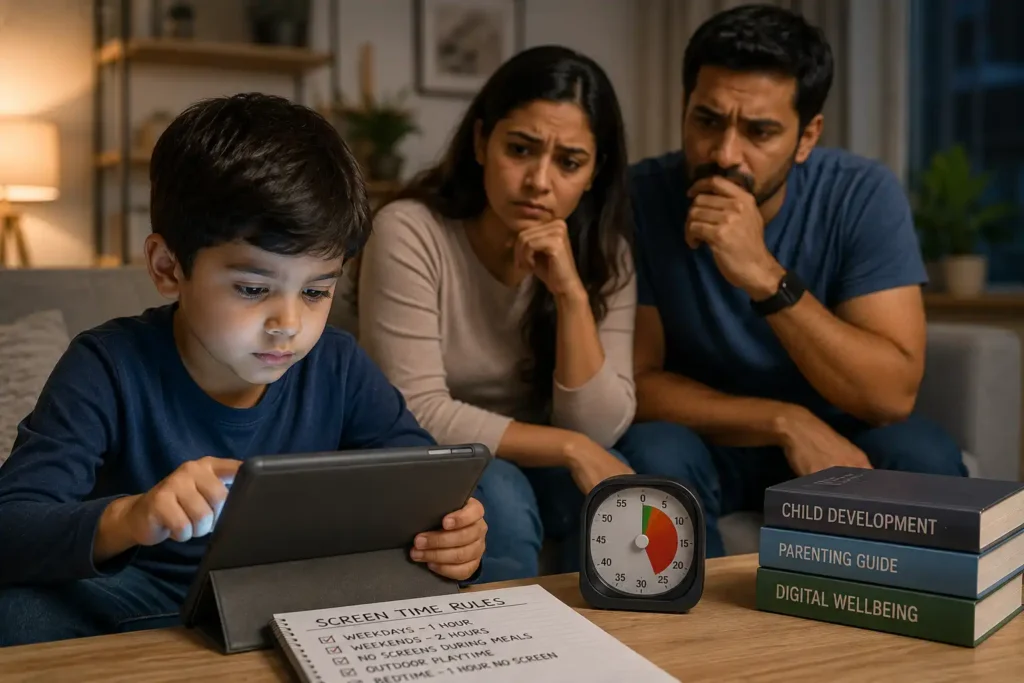
Most parents who land on this page already suspect they are over the line. The good news is that many families notice meaningful improvements within two to three weeks when they stay consistent.
1. Audit the actual baseline. Track screen hours for three days. Honestly. The number will be higher than your guess.
2. Tell your child what is changing and why. Even a four-year-old can understand: “We’re going to use screens a little less. It might feel difficult for a few days, and that’s okay. We’ll get through it together. I love you.”
3. Replace the highest-use slot with something physical or social. If the afternoon is the screen slot, that is the slot to fill with a park visit, a friend visit, a craft project, or even just outdoor time.
4. Hold the line for the cranky days. Days 2 through 5 are the worst. The meltdowns are real. In many cases, the screens were masking underlying frustration or difficulty with transitions.
5. Re-set the rule at the new lower level. For many families, within two weeks the new routine starts to feel more natural. Kids are more adaptable than parents give them credit for, when the parent is consistent.
The hardest part is not the kid. It is the parent. We use screens as our break, and the reset costs us our break too. That is real.
Five Common Screen Time Mistakes I See in My Practice
1. Using screens as the only off-switch. When every overwhelm gets screen time, kids never learn other regulation tools.
2. Background TV all day. Even when the kid is not “watching,” the constant audio and visual input can interrupt play, language development, and family connection.
3. Phones at meals. Family meals are one of the strongest connection rituals in childhood. Phones at the table dilute it across years of small dinners.
4. Negotiating screen time in real time. “Five more minutes” turns into thirty. The rule has to be pre-set so the moment of asking is not the moment of deciding.
5. Guilt-driven reactions. A parent who feels guilty about yesterday’s three hours often overcorrects today with zero, then breaks by 4 PM. Sustainable beats perfect, every time.
If you recognise three or more of these, you have not failed. You are in the most common parenting moment of this decade. The fix is calmer than you think.
Age-Banded Quick Reference
| Age | Recommended daily limit | What works | What does not |
| 0-18 months | None except video chat | physical contact, talking, music | Background TV, solo screens |
| 18-24 months | Limited co-viewed | High-quality slow shows, parent narrating | Algorithm-driven content, autoplay |
| 2-5 years | Up to 1 hour | Familiar show, co-viewed, predictable | YouTube Shorts, TikTok, unfamiliar app |
| 6-9 years | Individual limits agreed upon by the family. | Pre-decided slot, varied content, family viewing | Hidden devices, unrestricted access |
| 10+ years | Family-agreed limits | Conversations about content, gradual autonomy | Bedroom devices overnight |
This is a working frame, not a prescription. Adjust to your child, your household, your weekend versus weekday.
When to Bring in Outside Support
Most screen time issues can be resolved at home with clarity and a two-week reset. Bring in a qualified professional when:
1. The child’s sleep has been disrupted for over a month
2. School performance has notably dropped and the parent suspects screens
3. The child shows significant irritability or persistent distress, such as refusing other activities, for more than two weeks after a reduction attempt.
4. The parent feels they cannot hold the rules without daily conflict
5. There are concerns about specific content the child has accessed unsupervised
Outside support is not failure. It is acceleration.
Final Thoughts
The screen time question is rarely about screens. It is about how you, the parent, want to spend the next ten years with this kid. Some of those years will include screens. Most of them, ideally, will not be defined by screens.
So the 4:47 PM moment matters less than the Sunday morning decision. Set the rule when calm. Hold it during the cranky days. Replace screen time with something specific. And give yourself some slack on the days the rule slips, because it will.
You are not raising a screen-free child. You are raising a child who has a healthy relationship with screens, which is a different and more useful goal.
If you’d like more personalised support in creating healthy screen habits, Vedangi Brahmbhatt’s Conscious Parenting Course offers practical strategies that fit real family life.
FAQs
Q1. How much screen time is recommended for children by age?
A. General guidelines recommend no screen time (except video calls) for children younger than 18 months, limited co-viewed content for those 18–24 months, up to one hour of high-quality programming for those ages 2–5, and consistent family-set limits for children 6 years and up.
Q2. How can I tell if my child is getting too much screen time?
A. Other warning signs are frequent meltdowns when screens are turned off, less interest in imaginative play, changes in sleep, difficulty concentrating, or noticeable changes in behaviour or language.
Q3. What’s the best way to reduce my child’s screen time?
A. First, monitor their current screen time habits. Then, calmly discuss the new rules. Substitute screen time with engaging activities, and be consistent during the initial adjustment phase. Most families notice improvement within a few weeks.
Q4. Is all screen time equally harmful?
A. No. High-quality, age-appropriate content watched with a parent is generally better than fast-paced, autoplay or short-form content watched alone. It’s not just about how long you’re on the screen but how you’re using it.
Q5. When should I seek professional help for screen time concerns?
A. If you notice that screen use is impacting your child’s sleep, academic performance, emotional regulation, or if you have consistently tried to reduce screen time and your child is still struggling, consider discussing with a professional.